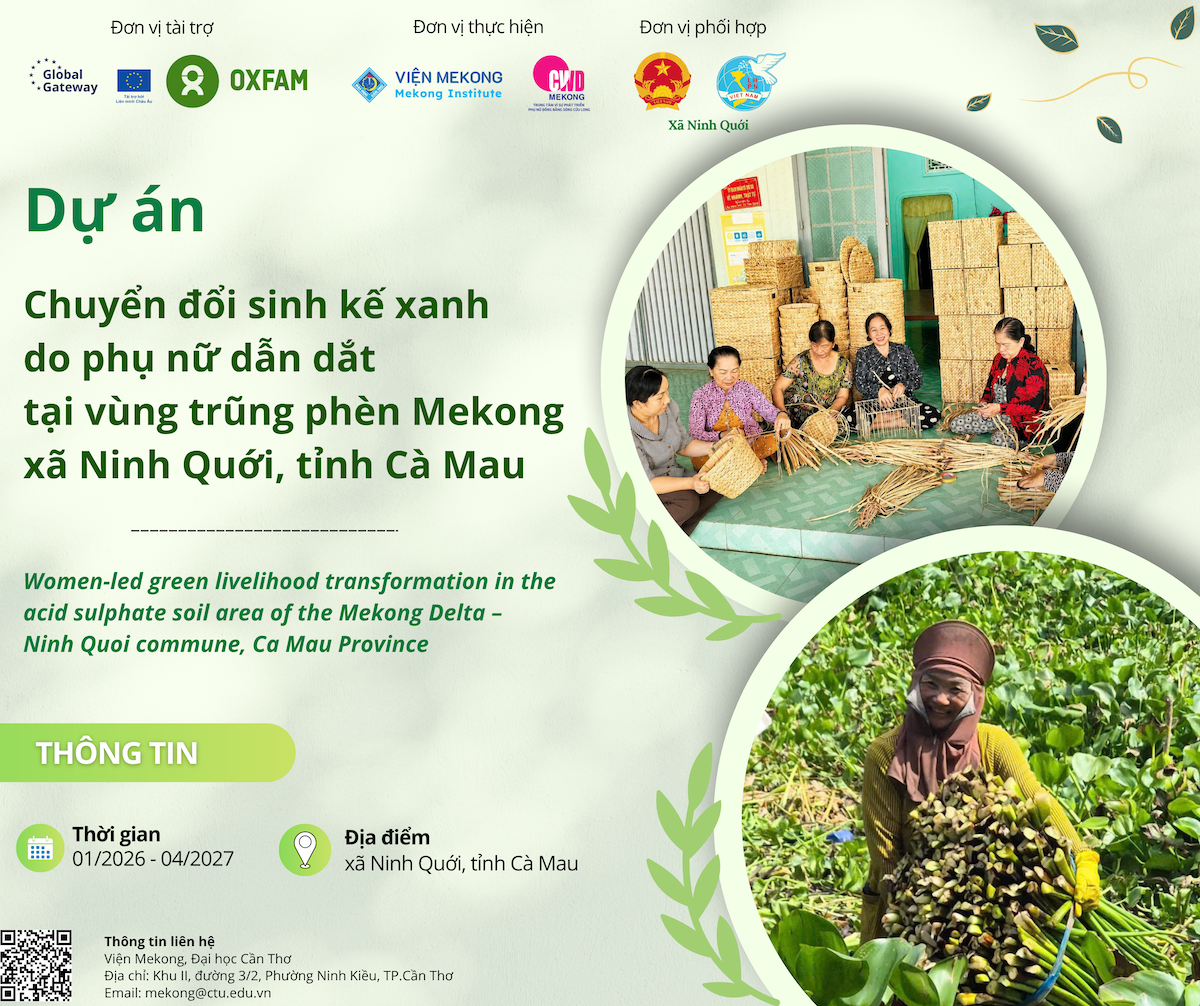
Ninh Quoi commune in Ca Mau province (a typical acid sulfate wetland of the Mekong Delta) is facing severe challenges from climate change, freshwater scarcity, and critical land subsidence. Local livelihoods remain highly precarious, relying heavily on two-crop rice farming. Meanwhile, supplementary income from water hyacinth crafts faces high market risks and limited production scale. In this context, while women play a central role in maintaining household economies, they still lack access to technical training and business skills, while bearing a heavy burden of unpaid care work. This reality underscores an urgent need to diversify sustainable livelihoods and enhance adaptive capacity for the community, particularly for marginalized groups of women.
To help address these challenges, the Mekong Institute – Can Tho University, in collaboration with the Center for Women’s Development in the Mekong Delta and the People's Committee of Ninh Quoi Commune, is implementing the project "Women-led green livelihood transformation in the acid sulphate soil area of the Mekong Delta – Ninh Quoi commune, Ca Mau Province". The project is funded by the "Promoting Women-Led Green Transformation Initiatives" (PWG) project. The PWG project is a component of the "Women-Led Green Partnership Program" funded by the European Union and implemented by Oxfam in Vietnam.
This community support initiative is part of the Mekong Institute’s core strategic mission to accompany communities in responding to complex climate change. Through this, the project affirms the Mekong Institute’s commitment to supporting local areas in developing sustainable and resilient livelihood models. This is also a practical step aligned with the Government's general direction toward green transformation, promoting gender equality, and proactively responding to climate change.
The project runs from January 2026 to April 2027. It aims to foster women-led green transformation in the Mekong acid sulfate wetland area of Ninh Quoi commune, Ca Mau province. This will be achieved by developing livelihoods based on indigenous resources that adapt to climate change, while strengthening women's voices and participation in local decision-making and policy-planning processes.
The project focuses on the following key activities:
- Developing women-led, climate-resilient livelihoods based on indigenous resources, aligned with green transformation practices tailored to acid sulfate wetland conditions.
- Building capacity for production, business operations, and financial access for local women-led enterprises (collaborative groups, cooperatives) linked to green markets through a value-chain approach.
- Promoting the role of local women in building climate change response policies, disaster risk reduction, and environmental protection through dialogue workshops and policy feedback reports.
The project is expected to create a model for green livelihood development with active participation and leadership from women, contributing to the Sustainable Development Goals (SDGs) and the national strategy on climate change adaptation in the Mekong Delta.
🌐Find out more information:
- Website: http://europa.eu
- Facebook: https://www.facebook.com/EUandVietnam/
Hashtags: #EUfunded #PWG